
California Voter Registration Self-Check for Berkeley
The first stop for a Berkeley voter is the California Secretary of State voter-status tool at voterstatus.sos.ca.gov, linked from registertovote.ca.gov. It is built for a voter checking personal registration, address, and election information, not for looking up neighbors or browsing a voter roll. The registration site also explains that online registration uses personal identifiers to confirm eligibility and retrieve a DMV signature; those identifiers are not public search fields.
| Lookup item | How it appears | Required? | Berkeley use note |
|---|---|---|---|
| Check Your Registration Status | Action from the state registration site | n/a | Use this to confirm your own status and address details. |
| California driver license or ID number | Identifier for online registration | Required when available | Used for registration and signature matching, not public lookup. |
| Last four digits of Social Security number | Identifier for online registration | Required when available | Protected identifier; do not expect it in any public output. |
| Date of birth | Date field for registration | Required for online registration | Used to verify the voter; not a third-party search field. |
| Safe at Home warning | Notice on registration page | n/a | Participants are told not to use the regular online form. |
If the state tool does not answer a Berkeley election question, route the issue to the Alameda County Registrar of Voters rather than trying to treat the self-check as a public directory. The county office is the local elections office for Berkeley voters, while California controls the restricted statewide file.
Who Routes Berkeley Voter Records Locally
Berkeley is in Alameda County, and the Alameda County Registrar of Voters at acvote.alamedacountyca.gov is the local office for registration administration, election resources, voting by mail, polling-place information, and election transparency materials. The City of Berkeley voting page at berkeleyca.gov sends residents to Alameda County for general voter information while keeping Berkeley-specific municipal election material in the city records stream.
That split matters. A question about whether a Berkeley resident is registered or where to vote belongs with the state lookup and Alameda County. A question about Berkeley voter guides, city election results, council election materials, or local ballot information may point to Berkeley Records Online at records.cityofberkeley.info. The two systems overlap around elections, but they do not expose the same records.
Source capture from the manifest includes the Berkeley voting-information page:
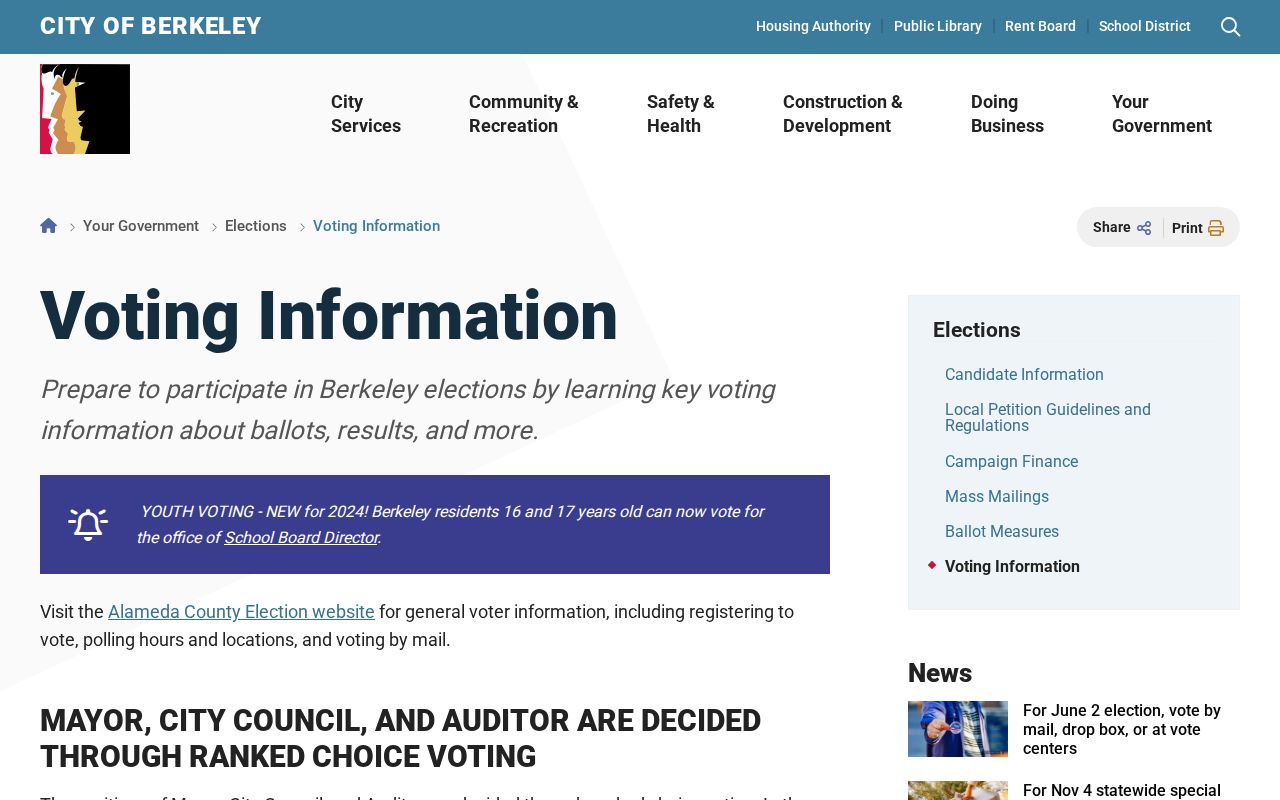
The city page is useful because it shows where Berkeley election questions stay local and where residents are sent to the county office.
What a California Voter Record Can Show
The full California file is a restricted record set. When an approved request is granted, the state materials describe voter data, voting history, and district information as separate plain-text, tab-delimited files for broader county, district, or statewide requests. A specific voter-record request is narrower and is limited by the exact information supplied on the application. None of this turns voter registration records into an open name-search site.
| Voter name | Not exposed by the public self-check; may be included for approved applicants. |
|---|---|
| Residence address | Restricted file field when permitted, with confidential and protected voters withheld or limited. |
| Mailing address | May appear in approved file access; use remains limited to the approved purpose. |
| Party preference | Included where the voter has provided a California party preference. |
| Status | The self-check can return status to the voter; approved files may include maintenance status. |
| Precincts and districts | Election tools can show voter-specific election data; approved bulk files include a district file. |
| Voting history | Participation history only. It never shows ballot choices. |
| Registration date | Availability depends on the extract or request type. |
Confidential by law. Driver license numbers, Social Security number information, signatures, protected voter information, and other confidential fields are not released through the voter file. California controls the file through Elections Code sections 2188, 2194, 18109, Government Code section 7924.000, California Code of Regulations sections 19001-19013, Business and Professions Code section 17538.41, and protected-voter rules including Elections Code section 2166.9.
Berkeley Voter Registration File Inventory
For Berkeley research, think of the file as three related inventories rather than one simple profile page. The state application describes bulk approved requests as an encrypted DVD with a voter data file, a voting history file, and a district file. Specific voter-record requests are sent differently, by encrypted WinZip email attachment, and each application is capped at 10 specific records.
| File or record type | What it may show | What it does not show |
|---|---|---|
| Voter data file | Name, address fields, party preference, status, registration-related fields where released. | Confidential identifiers, signatures, and protected voter addresses. |
| Voting history file | Election participation history linked to the record. | Candidate choices, ballot selections, or how a person voted. |
| District file | Precinct and district assignments for approved bulk requests. | Private identifiers or confidential program data. |
| Specific voter record | A narrow record based on details supplied by the applicant. | More than 10 records per specific-record application. |
Requesting the California Voter File for Berkeley
The Secretary of State voter-file application is the controlling route for statewide, county, district, and specific-voter requests. The application must be mailed or hand-delivered to the Secretary of State at 1500 11th Street, 5th Floor, Sacramento, CA 95814; emailed and faxed applications are not accepted. Berkeley records sit within the Alameda County and statewide voter systems, so the applicant must identify the desired geography and purpose rather than asking Berkeley City Hall for an unrestricted voter list.
| Step | Requirement | Detail from the state application |
|---|---|---|
| 1 | Choose request type | County, statewide, district, or specific voter record; specific-record applications are limited to 10 records. |
| 2 | State the purpose | Permitted purposes include approved election, scholarly, journalistic, political, or governmental uses with detailed explanation. |
| 3 | Include ID | A clear copy of a current driver license or state identification card is required. |
| 4 | Pay the fee | Registration data is $15 per thousand records, maximum $100. A specific voter record is $30 per record, maximum $100. |
| 5 | Wait for review | The Secretary of State reviews completeness and lawful purpose in 7-14 business days after receipt. |
| 6 | Receive approved data | Bulk files are distributed on encrypted DVD; specific records are sent by encrypted WinZip email attachment. |
Questions about the state process go to the VoteCal Help Desk at (888) 868-3225 or votecalhelp@sos.ca.gov. The state says it provides no end-user technical support and no refunds once data is sent.
Source capture from the manifest includes the California voter-file request page:
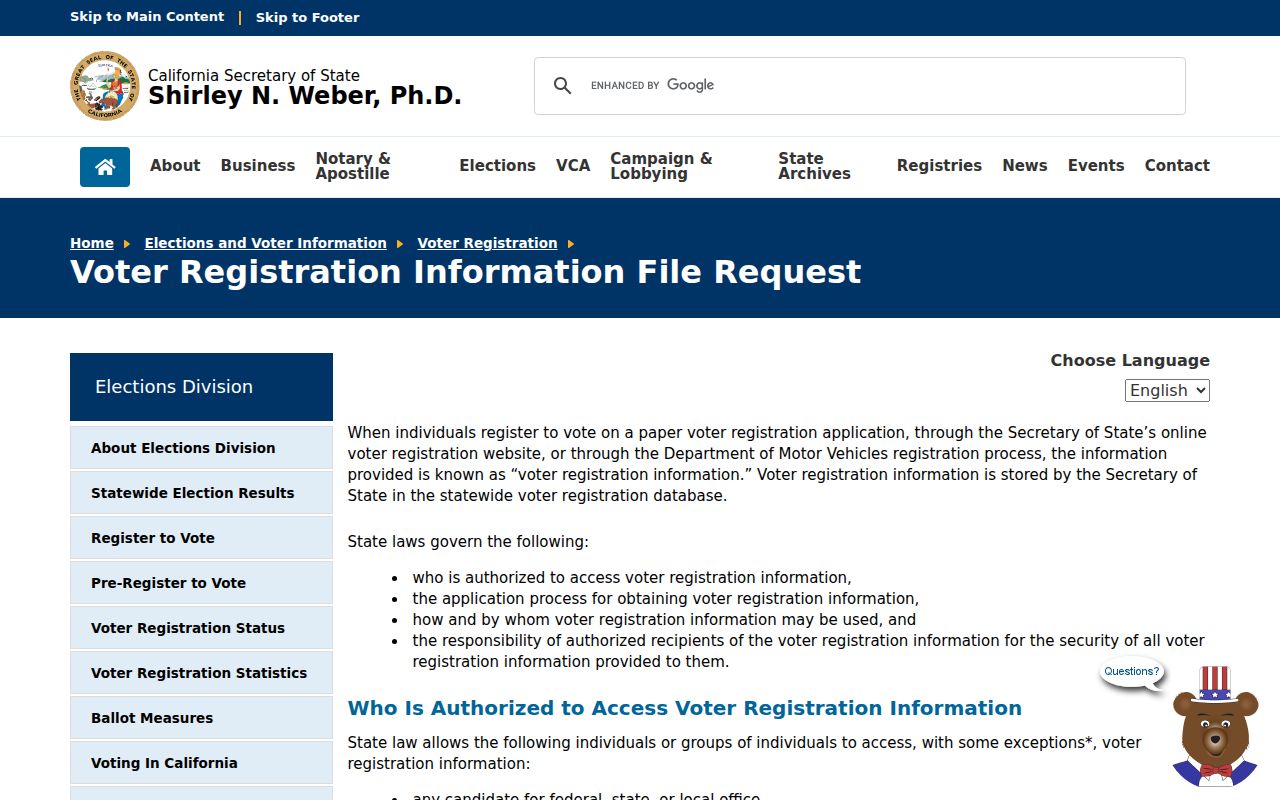
The page matters for Berkeley because it is the official starting point when a request moves beyond a personal status check.
Use Limits and Penalties for Berkeley Voter Data
The state application is explicit that voter registration information is not public data. Approved access is tied to the purpose the applicant gives, and the file may not be repurposed after delivery. Prohibited conduct includes unapproved use, unauthorized sharing or transfer, harassment of a voter or voter household, advertising or marketing use, leaving data unsecured or publicly available, and certain text-message advertising without opt-out rights.
Penalty note. Misuse can be charged as a misdemeanor with significant fines under Elections Code section 18109. For a Berkeley-focused request, keep the approval, purpose statement, and security obligations with the data so later use can be checked against the original authorization.
Safe at Home and Confidential Voter Registration
California Safe at Home is run by the Secretary of State and is designed to shield eligible participants' residential addresses by using a substitute program address. The state registration page warns Safe at Home participants not to use the regular online form and says they may be eligible to register to vote confidentially. The program phone number in the research file is (877) 322-5227.
For Berkeley searches, this is not a minor exception. A protected record may be withheld or limited even when an applicant otherwise qualifies for voter-file access. It also means a missing voter entry, absent address, or substitute address should not be treated as evidence that no registration exists.
Berkeley Election Results, Guides, and Youth Voting
Berkeley Records Online contains city election results and voter guides alongside ordinances, resolutions, minutes, council communications, and contracts. Those materials help reconstruct public election activity, candidate information, local ballot questions, and municipal voting history. They are different from the restricted voter file because they document the election process rather than exposing individual voter profiles.
Berkeley also has a local election detail that should not be generalized statewide: residents ages 16 and 17 can vote for the office of School Board Director beginning with 2024. That rule affects Berkeley election administration and voter guides, but it does not make youth voter records public or change California voter-file restrictions.
Historical Voter and Poll Trails in Berkeley
Historical election research in Berkeley depends on city, library, and archive sources rather than a single modern voter lookup. Berkeley Records Online is the city path for election results and voter guides. Berkeley Public Library and the Berkeley History Room hold local-history materials that can include newspapers, campaign material, old guides, city directories, and related civic records. The California State Archives family-history and local-government collections may include historical registration, poll, or election records depending on the county record group.
The research did not locate verified Alameda County poll-book or voter-register years in official sources, so the reliable path is to start with known Berkeley election guides and results, then use the library and archives for older context. For older identity work, directories can supplement election records because Berkeley appears in Oakland/Alameda/Berkeley directory runs from the 19th and early 20th centuries.